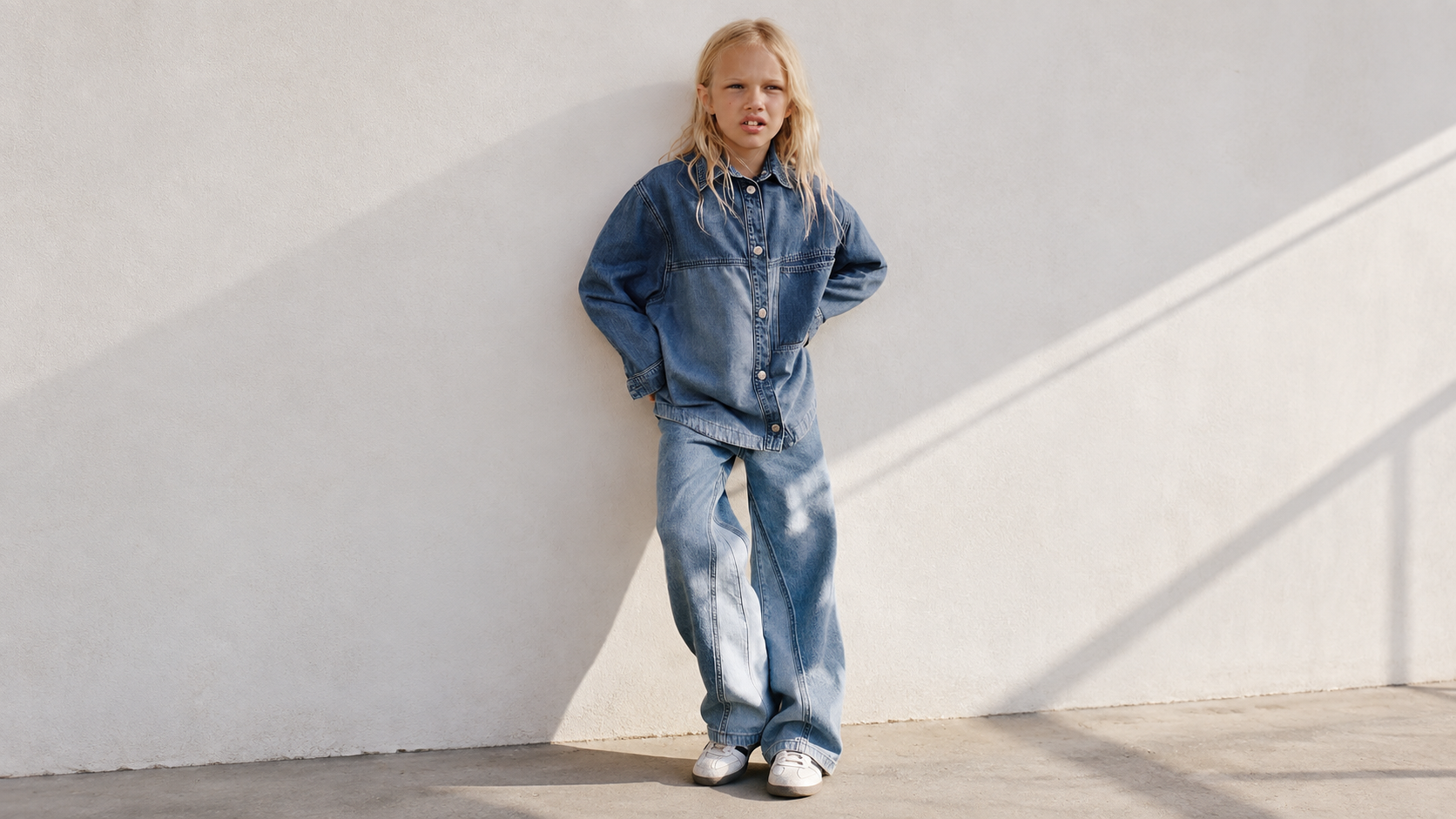
Two children’s jeans can share the same cotton composition, colour description and relaxed-fit label, yet communicate very different value.
For buyers developing private label kids clothing, the difficult decision is knowing which differences deserve a higher factory price. Is the appeal coming from the denim itself, the proportions, the wash or the decoration? And which of those qualities will survive a cost reduction?
A useful starting point is to identify the feature that gives the garment its character—and protect that feature throughout development.
What Zara and H&M Can Tell Us—and What They Cannot
Zara’s US boys’ jeans assortment includes relaxed baggy denim, offering a reference for silhouette-led product development. H&M’s embroidered wide-leg jeans combine a roomy shape with decorative motifs and an adjustable waist. These are observable product choices, rather than evidence of either brand’s sales performance. Zara boys’ jeans, H&M embroidered wide-leg jeans.
The buyer’s opportunity is to separate the appeal of the shape from the appeal of the surface.
Would the style still look distinctive without its embroidery? Would it retain its character in a different denim? If the answer changes, so should the development budget.
The analysis below is a buying framework, not a reconstruction of either brand’s factory costs or production methods.
1. A Silhouette-Led Style Needs More Than a Wider Leg
When the attraction is a relaxed or wide-leg shape, the fabric and pattern must work together. Adding width to an existing slim-fit block does not necessarily reproduce the intended proportion.
Rise, seat volume, pocket placement and leg opening all affect the result. Fabric behaviour matters too: a softer denim may fall close to the body, while a firmer option may hold more volume.
This creates a buying trap. A substitute fabric can match composition and colour on paper while changing the appearance of the finished garment.
For a silhouette-led style, compare fabric alternatives in the same garment shape after the intended wash. A swatch comparison alone cannot show how the leg hangs or how the seat looks in movement.
Budget priority: protect the fabric–fit relationship before adding decorative details. A less elaborate style can still feel considered when its proportions are convincing.
2. “Softer” and “Heavier” Are Incomplete Upgrade Requests
Buyers often ask for softer denim to improve comfort or heavier denim to communicate quality. Both requests need a more specific product intention.
A lightweight, fluid fabric may suit an easy summer silhouette. A more structured fabric may better support a sculpted leg. Neither is automatically the premium choice.
The useful question is: what should the garment do when worn?
Define whether the fabric should hold a shape, drape, stretch with movement or maintain a crisp surface. Then assess candidate fabrics against that intention, including their condition after laundering.
For babywear, a visual reference from older children’s denim also needs reconsideration around movement, bulk and access for changing. The same styling idea may require a different construction.
Budget priority: pay for behaviour that supports the design. Avoid upgrading fabric weight or softness without checking whether it improves the finished product.
3. A Wash Reference Is an Appearance Target, Not a Complete Specification
A photograph can communicate the desired shade and contrast. It cannot establish the exact route needed to achieve them on your chosen fabric.
The starting denim, garment construction and finishing process interact. Changing the base fabric while asking for “the same wash” may require further development.
The commercial issue is also consistency. A striking sample is useful only if the agreed appearance can be reproduced within an acceptable range.
For a repeat-order style, ask the kidswear manufacturer to distinguish between the approved target and acceptable variation. Review representative garments together, rather than judging each sample in isolation.
Budget priority: when wash is the main source of character, assess repeatability alongside appearance. A cheaper option that changes the visual identity is a different product proposition.
4. Embroidery Cost Is Not Explained by Motif Size Alone
Two similarly sized motifs can require different production effort. Stitch density, colour changes, placement, access during sewing and backing requirements can all influence the result and quotation.
For children’s denim, the reverse side matters as well. A decorative surface should be assessed alongside local stiffness and how the inside feels against the body.
When reducing cost, ask for alternatives that preserve the design’s focal point: fewer placements, a simplified fill or a revised motif layout. Compare physical samples before assuming that the least expensive option offers the best value.
For a clear comparison, use the same artwork version and placement references across quotations. The kidswear artwork handover guide explains how to keep those inputs consistent.
Budget priority: preserve the feature shoppers notice first, then simplify supporting decoration.
5. Ask for Cost Alternatives That Reveal the Trade-Off
A request to “reduce the price” leaves too much room for changes that weaken the original idea.
Instead, ask your custom kids clothing manufacturer to compare defined versions:
Silhouette-led denim: protect fit and fabric behaviour; sample a version with simpler decoration.
Silhouette-led denim: protect fit and fabric behaviour; sample a version with simpler decoration.
Wash-led denim: protect tonal character and consistency; sample a version with less decorative hardware.
Wash-led denim: protect tonal character and consistency; sample a version with less decorative hardware.
Embroidery-led denim: protect motif impact and inside comfort; sample fewer placements or simpler artwork.
Embroidery-led denim: protect motif impact and inside comfort; sample fewer placements or simpler artwork.
These are development options, not guaranteed savings. Their value depends on the construction, quantities and production route.
Keep the size range, order quantity and other specifications consistent when comparing prices. Otherwise, the apparent saving may come from a different assumption rather than a better product decision. See the kids clothing manufacturing quote comparison guide.
Give the Manufacturer a Commercial Priority
Before requesting the next sample, complete this sentence:
“Customers should choose this style because of ______, so any cost revision must preserve ______.”
That statement gives an OEM/ODM discussion a clear direction. It helps distinguish an acceptable simplification from a change that removes the reason for buying the garment.
For buyers discussing a private label collection with QH Apparel, a kidswear manufacturer, a useful starting brief includes the target retail position, intended silhouette and the single product feature that must survive cost optimisation.
The strongest denim development decision is often knowing exactly where extra spending will be visible—and where it will add little to the product.
Brand references are provided for independent product analysis. No affiliation, supplier relationship or access to brand production costs is implied.For a closer look at decoration pricing, read why the same-sized kidswear embroidery motif gets different quotes, including the trade-offs behind artwork simplification and fewer placements.